Avery Hill Park, Greenwich, Sunday 15 September 2024.
St Anne’s Allstars 208-7 (35 overs: Vijay Mishra 50* ret; Anand Pichaimaini 50* ret, Mathan Olaganathan 40, James Samdham 3-20) beat Plastics 201-7 (35 overs: Charlie Bradbury 51* ret, Roger Golding 50* ret, Mathan Olaganathan 2-21, Gren Thompson 2-27) by 7 runs.
Allstars Debuts: Anand Pichaimaini, Uffan Salimi, Vijay Mishra, Zain Javed.
Report and photos by Maxie Allen
An enthralling match. A narrow win. Nice weather. A pleasant venue. And a friendly oppo.
Altogether, what they call in the trade ‘a good day out’. But the real success was getting a full side on the field in the first place.
Recruitment had not been straightforward. This fixture took us to Avery Hill Park in the Royal Borough of Greenwich. And for our visit to the home of time, we had to show some latitude on team selection.
In truth, I was a rusty match manager. This was the first Allstars fixture I’d overseen for three years, and as luck would have it, Spond revealed a grand total of six players had made themselves available.
Hence I began the usual process of trying to force people to play a cricket match. “Hello, you barely know who I am, but would you like to traipse to the arse-end of south-east London to chase leather for me all day?”
Every tactic from subtle persuasion to blackmail and outright coercion failed to yield dividends. In desperation I turned to the Fixture List, our sport’s version of Grindr – providing casual hook-ups for the cricketing desperate.
For those unfamiliar, the Fixture List website links up clubs looking for extra players with players looking for a game. It supplies both swings and roundabouts. Yes, it can solve a problem – but you also have to kiss a lot of frogs: inquiries which go nowhere, and respondents who are time wasters.
Using the Fixture List is not unlike trying to sell a baby buggy on Facebook Marketplace.
‘Hi, is your buggy still for sale?’
‘Yes. Would you like it?’
And you never hear from them again.
So after placing a listing on the site, and as replies began to trickle in, I played a mix of hardball and conviviality: showing appreciation for their interest but also determining whether they were serious and organised and reliable.
I asked questions. I assessed. I filtered. Those who passed my ‘tests’ were admitted to the holy sanctum of the WhatsApp group. Slowly but surely, I acquired a viable squad.
In fact, by Saturday night I had twelve players. But at 9pm I sustained a double-loss. One player, a regular Allstar, broke the discouraging news he was in Accident and Emergency. A second – one of five ‘guests’ from the Fixture List – messaged me to say he had a ‘family emergency’, words which for more than a century have been cricket code for ‘can’t be bothered’.
With fifteen hours to go, the squadometer now read 10, although the sub-XI total was partly mitigated by (a) the likely contribution of Felix’s son (my nephew Ned), and (b) Vivek could hang around for a while, after dropping off the kit, before returning to Shoreham to look after his dog.
All this generated the exact variety of exciting jeopardy which firmly distinguishes the experience of a village cricket captain from the likes of, say, Ollie Pope. He may have struggled for runs in his first two outings as England stand-in captain, but he didn’t arrive at Lord’s worrying whether four blokes he’d found on the internet would actually show up – or a fielding strategy based on an eight-year-old and a guy who had to leave early to walk the dog.
Against this backdrop, matchday dawned, and we sashayed our merry way to Avery Hill – which itself introduced another, geographical, layer of uncertainty. We’d never hired or even seen the venue before. As with four of our squad, it was an internet blind date – booked simply on the basis of being cheap (£109) and crucially, available.
This could easily have gone terribly wrong, but in truth, we lucked out. Upon arrival it was quickly and universally agreed that Avery Hill was A Nice Ground.
OK, the actual pitch was a bit meh. But there was a pleasing vista, undulating across felicitously apportioned greensward to the glass-domed Winter Gardens botanical house. There was a new-looking cafe and playground. The lavatories boasted generous provision of real loo rolls. And for a council park ground, there was a refreshing absence of motorbikes, nitrous oxide canisters, and the emergency services.
But pleasant as it was, not everyone found the venue easy to locate. En route, two Fixture Listers rang me to say they’d got lost. This set me the interesting challenge of trying to direct people I’ve never met, to a place I’d never been to.
Meanwhile, as our squad members trickled in, Plastics’ captain – a smooth operator by the name of Roger Golding – summoned me for the toss, which I won. Electing to make first use of the pitch, I considered my strategic options for the batting order.
On this subject, there are competing schools of thought. Some argue for steady accumulation. Others advocate bold strokeplay from the get-go. In the end I plumped for a third option: a top order comprised of the players who had actually turned up. Therefore, people batted in the sequence in which they arrived.
As play got underway, my thoughts turned to the consideration that 37% of the team were completely unknown quantities. What would happen? They might be brilliant players, terrible players, or – for all I knew – raging sociopaths on day-release from Wormwood Scrubs.
In the event, it couldn’t have worked out any better. All four proved to be really nice chaps, who totally ‘got’ what the Allstars are about. They were also – to a man – very decent cricketers, but not *too* good, if you know what I mean. It wasn’t cheating to have them.
But I did not know this when I sent two of them out to open the batting. And now another issue emerged: I could not for the life of me remember anyone’s names.
Remember, I’d not played for three years. Aside from the Fixture Listers, there were also two regulars I’d never met before – Mathan and John – and I hadn’t seen Samer for a long time either. Pretty much the only player I was entirely confident about was Felix – who had the advantage of being my brother.
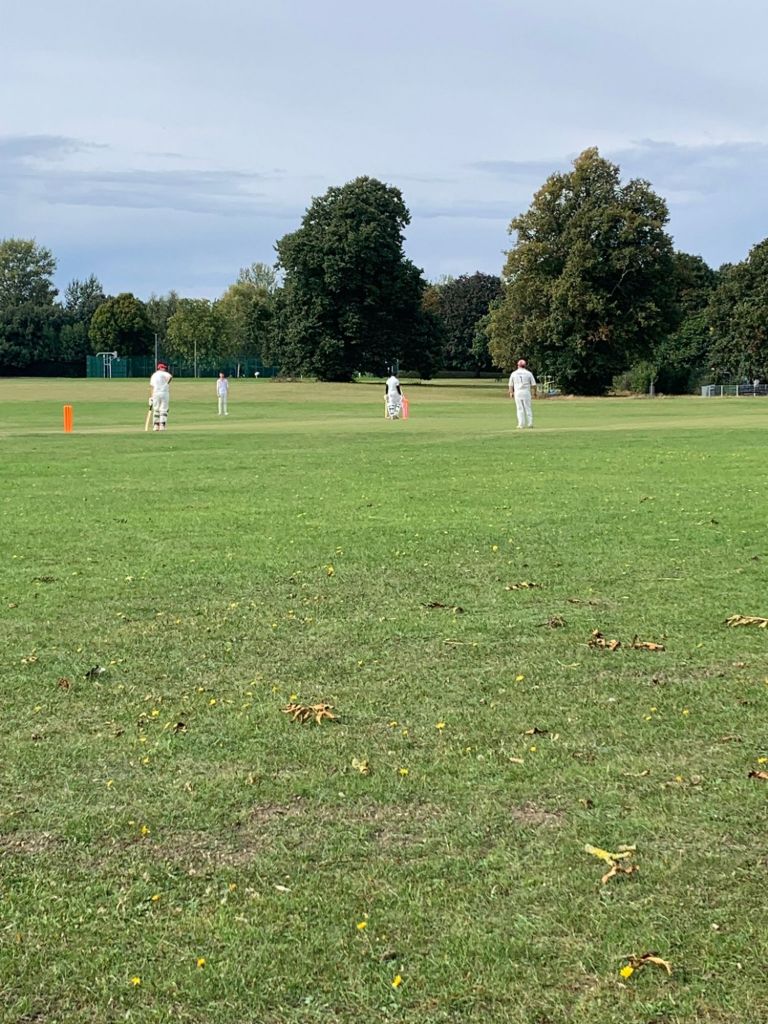
This amounted to a problem in making sense of the opening partnership between two of our brand-new guests, whose identities were a total mystery to me. It hardly helped they were the same height, both wore helmets, and were identically dressed. All I can tell you is there were good shots from Whatshisname and some confident strokeplay from The Other Fella.
The ball frequently reached the boundary. A few catching chances were offered but not accepted. Things went well. A bit too well, really. We reached 95-0 after 13 overs. So I decided to retire each of the openers when they reached 50.
[Editor’s note: Vijay Mishra struck seven 4s and two 6s for his fine unbeaten half-century, which he reached in 42 balls. At the other end, Anand Pichaimani made nine 4s and one 6, in his equally fine 37-ball fifty.]
These retirements were to have significant implications later in the match. At the time, they were purely acts of unilateral disarmament, as I’d not pre-agreed a retirement policy with the oppo. My intention was to open up the game, and it worked. With new batsmen at the crease, the tone changed. The bowlers had fresh purpose, runs grew harder to come by, and wickets began to fall.
Vivek Seth and newbie Uffan Salimi were the pair who replaced the openers, but neither lasted as long as they may have wished. Both were caught in the ring off leading edges. Having previously dropped everything, Plastics now began to catch everything, and all our wickets were to fall by this mode of dismissal.
That first brace of catches brought batsmen five and six to the crease – Mathan Olaganathan, and Samer Hafiz – and also a long phase of equality between bat and ball. The bowling was tidy and the pitch (which had the character of grumpy plasticine) became uncooperative. Sweet timing proved elusive, but both Samer and particularly Mathan took the scoring opportunities when offered.

Their partnership had realised 63 runs when Samer chipped another catch to the ring. However, it also used up 11 overs, and this relatively slow progress constrained us from batting Plastics out of sight. We continued in this vein for the remaining nine overs of our innings, scoring enough runs to make progress, but too few to secure the game. Felix had a poke about, and after Mathan’s dismissal for 40, John Kingston batted busily enough – with support from debutant Zain Javed and Gren Thompson – to get us to a total of 208.
At the time, I thought this was probably enough to win – and I was right, but only just. It soon became clear that Plastics’ batting was their stronger suit. Our bowlers generally bowled faster than theirs, but the extra pace made timing easier and the boundary seem shorter.
Such was the case from the very start of the innings. My initial bowling choices were determined partly by the imperative of canine exercise. One end was allocated to Vivek, so he could have a couple of overs before heading back to West Sussex for walkies.
At the other, Gren glided in with his customary speed and grace, rather like the Lloyds black horse, except with longer legs. He dispatched some excellent stuff, but any lapses in length were seized upon by Plastics’ captain Roger Golding, who looked rather tasty.
So did his partner Peter Bishop, until he attempted to whip Gren off his legs. The shot was a touch too ambitious, especially to such a lavishly swinging delivery. Its parabola resembled the type of banana of which EU officials would take a very dim view. The subsequent sound of ball on wood derived from Mr Bishop’s forlorn middle stump.
His successor, Dom Gillan, struck some meaty blows before falling victim to a ripper from Uffan Salimi. Although at that stage I was still unsure of his name, I had no doubts about the attractive quality of his off-spin, which supplied from the pavilion end (by pavilion, I mean kit bags strewn about).
Meanwhile, Mathan had replaced Gren and consolidated his reputation as one of those characters who’s just good at everything. He bowled briskly and accurately, and attacked the stumps with single-minded determination. His reward came with the wicket of Matthew Webb, whose innings was chiefly notable for a remarkably low-buttocked stance less associated with cricket than the moment in a game of Twister where you have to keep your foot on purple while reaching for green.
64-3 became 79-4 when Zain’s leg-spin induced a top edge from Plastics’ Robert Bishop, snaffled by wicketkeeper Anand. While the wickets fell, Roger Golding stood firm, and played what was probably the innings of the match. This was ‘proper’ batting. Above all, he was ruthless with anything overpitched and reeled off a series of crisp front-foot strokes, which earned him seven fours, including a regal off-drive (off Gren) of unimprovable peachiness.
So you can imagine our relief when Roger retired himself upon reaching 50, with Plastics’ score on around 100. On his part, this was a very magnanimous decision. He and I had no pre-agreement on retirements. He didn’t have to do it and only did it because we had done it. I tried to call Roger back, but he insisted, and the die was cast.
Shortly afterwards, Vijay trapped James Sandham leg before, and with Plastics now 109-5, I thought the match was won. It wasn’t to prove quite so simple. Plastics batted deep, and resourcefully.
Now at the crease was Murtaza Rizvi, who at first seemed hesitant but settled into a watchful innings in which bad balls were punished. Alongside him was Charlie Bradbury. He boasted an extremely good eye and forearms which wouldn’t look out of place if served for Christmas dinner.
Overall, Charlie was the kind of batsman I hate in village cricket, because he had that uncanny knack of hitting the ball exactly where the fielders weren’t and in fact never expected to be. He crunched it behind square. He dinked it over third man. He walloped it betwixt mid-wicket and long-on.
Game on.
Adding to my captaincy challenge were numerous fielding constraints. By this point Vivek had left. Instead we had Ned, Felix’s son, promoted from the Allstars Under-Nines squad. He applied himself extremely well. But for an eight-year-old in a full-scale adult cricket match, there are limitations. For one thing – and understandably – he wanted to field quite close to his dad. For long periods we had two mid-ons, three yards apart.
About half-way through the innings, Ned also had to depart, for a swimming lesson. This reduced us to ten players, and eight outfielders. In the circs it seemed churlish to ask the oppo for a spare, so we were left with more and bigger gaps in the field.

The difficulties were exacerbated by a distinctly two-tier hierarchy of fielding effectiveness. The four Fixture Listers – Zain, Uffan, Vijay, and Anand – plus Mathan and Gren, were youthful, lithe and quick. The rest of us were either old, injured, unfit, had a bad back, or in my case, all four.
When the ball was struck in our direction, the pursuit resembled someone walking through treacle while carrying heavy suitcases. And even after we finally apprehended the ball, the batsmen were easily able to run another two in the time we took to bend down and pick it up.
The fitter, faster fielders posed their own problem, because I still could not recall their names, at least not with confidence, and I kept mixing them up.
That had been awkward enough when we were batting and I could address individuals, face to face. It was all the trickier in the field, when there were loads of them, mostly far away, and I was required to attract the correct person’s attention in order to change their position.
“You over there, could you get to square leg? No not you. I mean…er…you“.
And so on.
Somehow, we just about kept a lid on things, largely due to some very decent bowling. We seemed to have a conveyor belt of proper bowlers, each one providing pace, accuracy, and good economy against accomplished batsmen. Gren finished with 2-27 from his seven overs. Mathan took 2-21 from his six. Vijay returned an equally impressive 1-28 from seven.
As a consequence, we held Plastics at bay, but only by a small degree. For the final 20 overs of their innings they were always about 15-20 runs behind the equation. This never seemed to change, although as the finish approached, the margins grew tighter.
With the score on 178, Mathan finally removed the obdurate Murtaza, ending a sixth-wicket stand of 69. Charlie continued to bash away. But crucially, he then reached his fifty – having struck six fours, and a six – and Roger retired him.
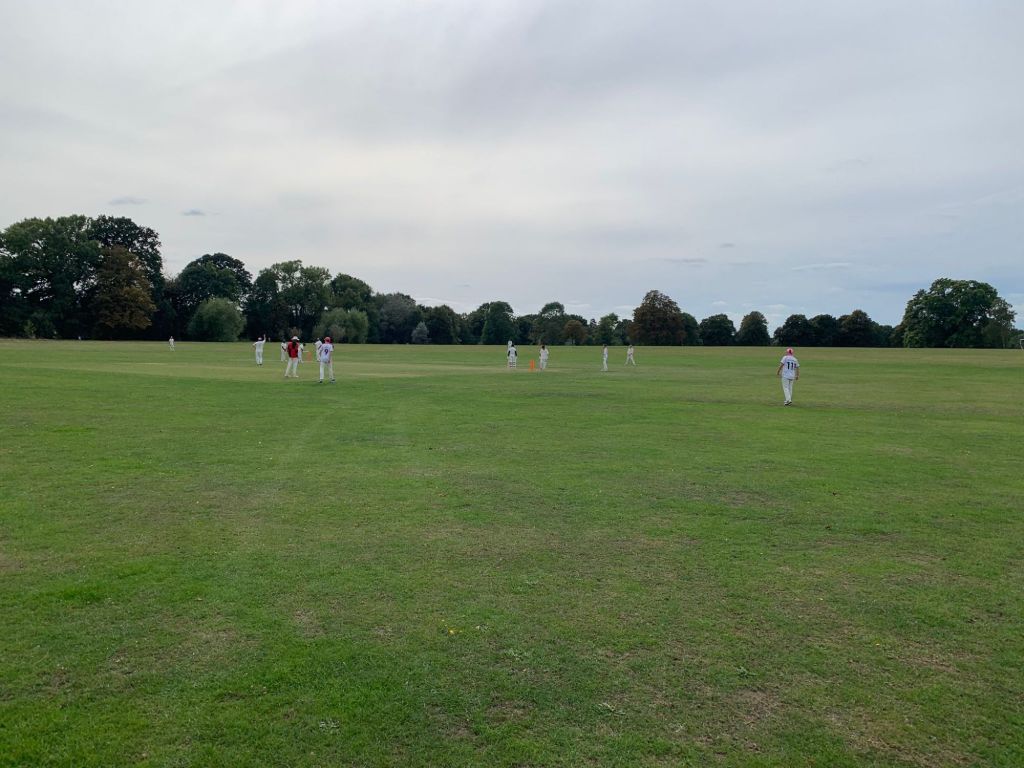
Like before, this was a very magnanimous act, as there’d been no official arrangement. Arguably it cost Plastics the match. On the other hand, if I’d not made the original decision to retire Vijay and Anand, they’d likely have batted Plastics out of the game before any real contest developed.
Tom King and Ian Whitfield were the new batsmen charged with getting Plastics over the line. The atmosphere grew tense. The end-of-over scores weren’t recorded, but they required roughly 20 from the last two, and 14 from the final over.
This meant they needed boundaries. But they didn’t get them. Gren and Mathan calmly closed things out, and we won by seven runs.
This completed an almost perfect Allstars match. Everyone got to bat and bowl. Everyone either scored runs or took wickets. And we won, but only narrowly and after a close contest played in a positive and friendly spirit by two sides who got on very well.
Indeed, in the pub afterwards, the Plastics proved excellent chaps and very good company. But I couldn’t remember their names either.
 St Anne's Allstars